To determine if a ruby is real, you can follow these steps:
-
Check the color: Real rubies are deep red, often with a slightly purplish tint. If the color looks too bright or unnatural, it may be synthetic.
-
Inspect the clarity: Natural rubies usually have inclusions or tiny imperfections. If the stone is flawless, it could be a synthetic ruby.
-
Scratch test: Rubies are one of the hardest gemstones, ranking 9 on the Mohs scale. If the stone scratches easily, it’s likely not a real ruby.
-
Use a jeweler’s loupe: A loupe can reveal natural inclusions known as "fingerprints," which are common in real rubies.
-
Check the price: If a ruby is sold at a surprisingly low price, it might be a fake or synthetic gemstone.
For a more reliable verification, it’s best to have the stone professionally tested by a gemologist.
What Is the Difference Between Garnet and Ruby?
Garnet and ruby are both precious gemstones, but they differ in several ways:
-
Color: Rubies are known for their distinct red color, often with a hint of purple. Garnets, on the other hand, come in a variety of colors, including red, green, yellow, and orange.
-
Hardness: Rubies are harder, with a Mohs hardness of 9, making them more durable than garnets, which have a Mohs hardness ranging from 6.5 to 7.5.
-
Chemical Composition: Rubies are a variety of the mineral corundum, containing aluminum oxide. Garnets are a group of silicate minerals, with different varieties based on their chemical composition.
-
Price: Rubies, especially high-quality ones, tend to be more expensive than garnets due to their rarity and demand.
-
Inclusions: Rubies often have inclusions, known as "fingerprints," while garnets tend to have fewer visible inclusions.
The key differences lie in color, hardness, and composition, which make rubies more valuable and durable compared to garnets.
How to Tell the Difference Between Garnet and Ruby?
To differentiate between garnet and ruby, consider the following characteristics:
-
Color: Rubies are typically a rich red with a slightly purplish tint, while garnets come in a broader range of colors, including green, yellow, and orange, in addition to red.
-
Hardness: Rubies have a Mohs hardness of 9, making them more durable than garnets, which range from 6.5 to 7.5 on the Mohs scale.
-
Clarity: Rubies often contain visible inclusions called "fingerprints," while garnets generally have fewer visible inclusions.
-
Price: Rubies tend to be more expensive due to their rarity and high demand, especially high-quality ones.
-
Weight: Garnets are denser than rubies, so a garnet of the same size will typically weigh more than a ruby.
By examining these key differences—color, hardness, clarity, and price—you can distinguish between a garnet and a ruby.
What Is the Difference Between Real Ruby Vs Fake?
The main differences between real rubies and fake rubies include:
-
Color: Real rubies have a deep, rich red color, often with a slight purplish tint. Fake rubies may look overly bright or lack the depth of color found in natural rubies.
-
Hardness: Real rubies are very hard, ranking 9 on the Mohs scale, making them resistant to scratches. Fake rubies, often made from glass or plastic, are much softer and can be scratched more easily.
-
Inclusions: Real rubies often have natural inclusions or "fingerprints," which are imperfections visible under magnification. Fake rubies tend to be flawless or have irregular inclusions that don't resemble those found in natural stones.
-
Price: Real rubies are significantly more expensive than fake rubies. If a ruby is being sold for a very low price, it is likely synthetic or fake.
-
Weight: Real rubies tend to be denser than fake rubies made of glass, making them heavier for the same size.
Having a ruby professionally tested by a gemologist is the most reliable way to confirm its authenticity.
What Does a Real Ruby Look Like?
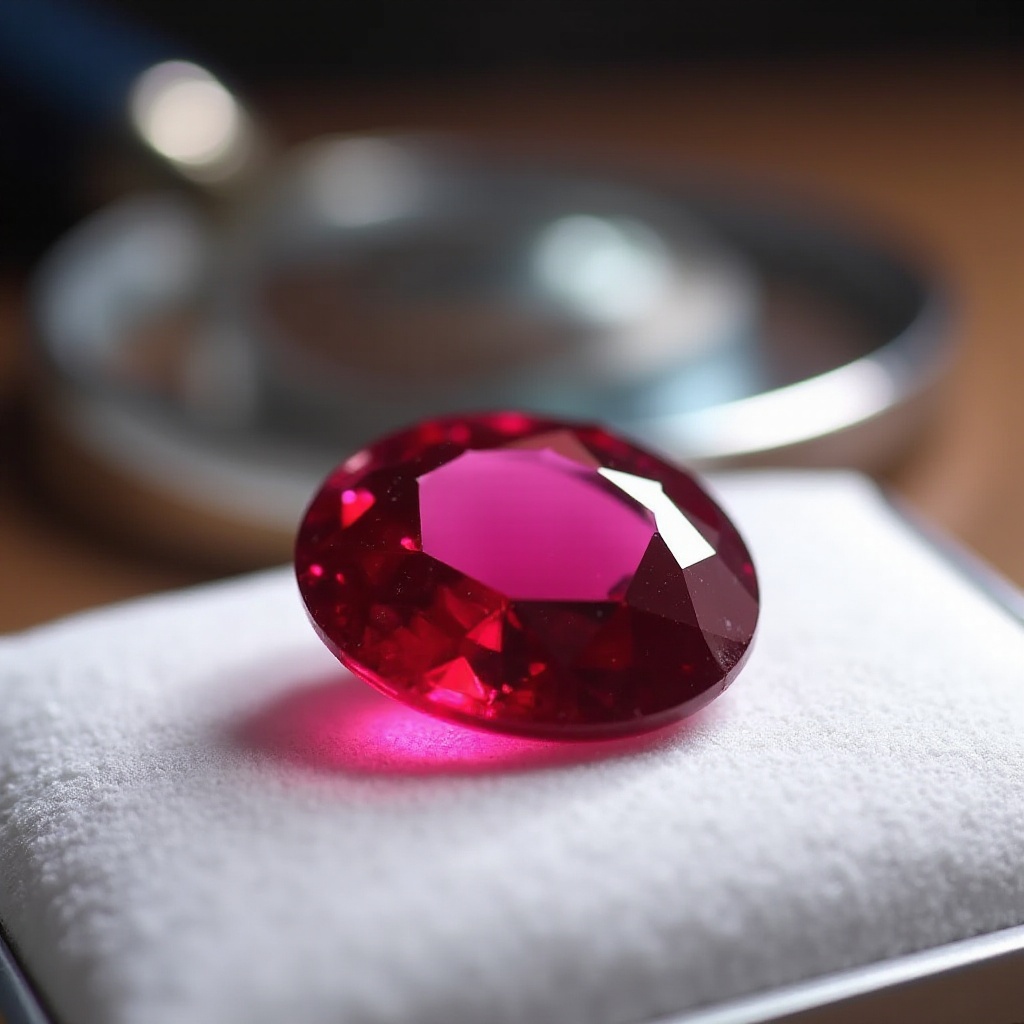
A real ruby is a vibrant, deep red gemstone, often with a hint of purple. Its color is one of its most striking features, ranging from rich blood red to a slightly pinkish or purplish hue.
The stone is generally transparent with some visible inclusions, often referred to as "fingerprints," which are natural imperfections that are unique to each stone. These inclusions can be observed under magnification using a jeweler's loupe.
Real rubies are hard and durable, ranking 9 on the Mohs scale of hardness, which makes them resistant to scratches. They often have a glossy, glass-like luster.
In terms of shape, real rubies can come in various cuts, including oval, cushion, round, and emerald, depending on the style and purpose of the jewelry piece.
A real ruby's price typically reflects its rarity and quality, with high-quality rubies being very expensive. If the ruby seems unusually affordable, it may be synthetic or imitation.
How to Identify a Raw Ruby?
Identifying a raw ruby involves looking for specific characteristics:
-
Color: Raw rubies are typically a deep red, ranging from dark crimson to a purplish hue. However, their color might be slightly duller than a polished ruby.
-
Shape: Raw rubies are often found in rough, uncut forms. They may have jagged, uneven edges and irregular shapes, unlike the smooth, polished shapes seen in jewelry.
-
Surface: The surface of a raw ruby may appear rough, sometimes with natural pits or grooves. These imperfections are a sign of a gemstone in its unrefined state.
-
Hardness: Like all rubies, raw rubies rank 9 on the Mohs scale of hardness. If scratched by a harder material, the stone is not a ruby.
-
Transparency: Raw rubies are generally opaque to translucent. Their transparency may improve once they are cut and polished.
-
Inclusions: Natural rubies often contain inclusions, which can appear as small cracks or mineral deposits. These "fingerprints" are common in rough rubies.
A professional gemologist can help confirm whether a raw stone is indeed a ruby.
Are Rubies and Sapphires the Same?
No, rubies and sapphires are not the same, though they are both varieties of the mineral corundum.
-
Color: The main difference is in their color. Rubies are always red, due to the presence of chromium, while sapphires come in a range of colors, including blue, pink, yellow, and green, depending on the trace elements present.
-
Composition: Both rubies and sapphires share the same chemical composition, primarily aluminum oxide, but the color variation is due to different trace elements—chromium for rubies and iron or titanium for sapphires.
-
Value: Rubies, especially high-quality ones, tend to be rarer and more expensive than most sapphires.
-
Hardness: Both rubies and sapphires are very hard, with a Mohs hardness of 9, making them durable gemstones suitable for various types of jewelry.
In summary, while they are chemically the same, their colors and rarity set rubies and sapphires apart.
How Does Ruby Vs Sapphire Vs Emerald Compare?
Ruby, sapphire, and emerald are all popular precious gemstones, but they differ in several key aspects:
-
Color: Rubies are known for their vivid red hues, sapphires come in various colors (primarily blue), and emeralds are distinguished by their rich green color.
-
Hardness: Rubies and sapphires are harder than emeralds. Rubies and sapphires both have a Mohs hardness of 9, while emeralds rank at 7.5 to 8, making them more prone to scratching and damage.
-
Rarity and Value: Rubies and emeralds are generally rarer than sapphires, especially high-quality stones. However, fine blue sapphires can also be very expensive, depending on color and size.
-
Inclusions: Rubies and sapphires typically have fewer visible inclusions compared to emeralds. Emeralds are often treated with oil to enhance clarity and may have more noticeable inclusions, known as "jardin."
-
Durability: Rubies and sapphires are more durable than emeralds, making them better suited for daily wear, while emeralds require more care due to their softer composition.
In summary, rubies and sapphires are harder and more durable, while emeralds are unique for their green color and tend to have more inclusions.
Do Rubies Glow Under Black Light?
Rubies can exhibit a fluorescence effect under ultraviolet (UV) or black light. When exposed to UV light, natural rubies may show a red or pinkish glow, caused by the presence of chromium, which is responsible for their color.
However, not all rubies will fluoresce strongly. The intensity of the glow depends on the specific ruby, its quality, and the amount of chromium present. Additionally, synthetic rubies may also show fluorescence, but their glow might differ from natural ones.
While fluorescence is a useful feature for gemologists when identifying rubies, it is not always a definitive test. Other methods, such as examining inclusions and conducting hardness tests, are also used for proper identification.
What Are Glass Filled Rubies?
Glass-filled rubies are natural rubies that have been treated with glass to enhance their appearance. This treatment fills visible cracks or inclusions in the ruby with a glass-like substance, improving clarity and creating a more vibrant color.
The process of glass filling makes the ruby more affordable, as it reduces the visual imperfections that would otherwise lower its value. However, it can also compromise the ruby's durability, as the glass filling is softer than the ruby itself.
While glass-filled rubies are still real rubies, they are typically less valuable than untreated or fully natural rubies. The treatment is often disclosed by jewelers to ensure transparency, as it can affect the gem's longevity and care requirements.
A gemologist can identify a glass-filled ruby through magnification, as the glass filling is typically visible and can differ in appearance from the surrounding ruby material.
What Is the Difference Between Lab Created Ruby Vs Natural Ruby?
The main difference between lab-created rubies and natural rubies lies in their origin:
-
Origin: Natural rubies are formed over millions of years within the Earth under high heat and pressure, while lab-created rubies are artificially synthesized in a laboratory using similar conditions in a much shorter time frame.
-
Composition: Both lab-created and natural rubies have the same chemical composition—primarily aluminum oxide with traces of chromium. However, natural rubies often contain unique inclusions, whereas lab-created rubies may have fewer or different inclusions.
-
Cost: Lab-created rubies are typically more affordable than natural rubies due to their controlled manufacturing process, which does not require mining.
-
Value: Natural rubies, being rarer and older, tend to hold more value in the market than lab-created rubies. They are also considered more unique due to their natural formation and inclusions.
-
Appearance: Both types can appear nearly identical to the untrained eye, though professionals can distinguish them based on inclusions and other characteristics under magnification.
What Is a Mahaleo Ruby?
A Mahaleo ruby is a specific type of ruby found in Madagascar, known for its unique and vibrant red color. The term "Mahaleo" refers to the region where these rubies are mined, specifically in the Mahaleo area of Madagascar.
Mahaleo rubies are often considered of high quality due to their rich, deep red hue and good clarity. However, like many rubies, they may also exhibit inclusions, which are typical in natural rubies. These inclusions are often visible under magnification.
Mahaleo rubies are valued for their rarity and beauty. They are not only used in high-end jewelry but are also sometimes marketed as a more affordable alternative to traditional Burmese rubies, offering similar qualities at a lower price point.
While Mahaleo rubies are natural, some may be treated to improve their color or clarity, similar to other rubies on the market.
Can You Break a Ruby?
Yes, rubies can be broken, but they are one of the hardest gemstones, ranking 9 on the Mohs scale of hardness. This makes them highly resistant to scratches and wear. However, rubies are not indestructible.
Despite their hardness, rubies can be fractured or chipped if struck with significant force or impacted at certain angles. Natural rubies, especially those with inclusions or cracks, may be more vulnerable to breaking under pressure.
To avoid damaging a ruby, it's important to handle it carefully, especially in jewelry pieces like rings, which are exposed to more daily wear and tear.
What Is a Star Ruby?
A star ruby is a unique variety of ruby that displays a star-shaped pattern on its surface, caused by the presence of rutile inclusions. These needle-like inclusions reflect light in a way that creates the star effect, visible under direct light.
The star typically has four, twelve, or twenty-four rays, depending on the arrangement of the rutile inclusions. The star effect is most noticeable when the ruby is cabochon-cut, as this shape enhances the visibility of the star.
Star rubies come in various colors, but the most prized are those with a deep, rich red hue. They are considered rare and are highly valued by collectors and jewelers.
This star phenomenon adds an additional level of uniqueness to the ruby, making star rubies distinct from regular rubies, both in appearance and value.